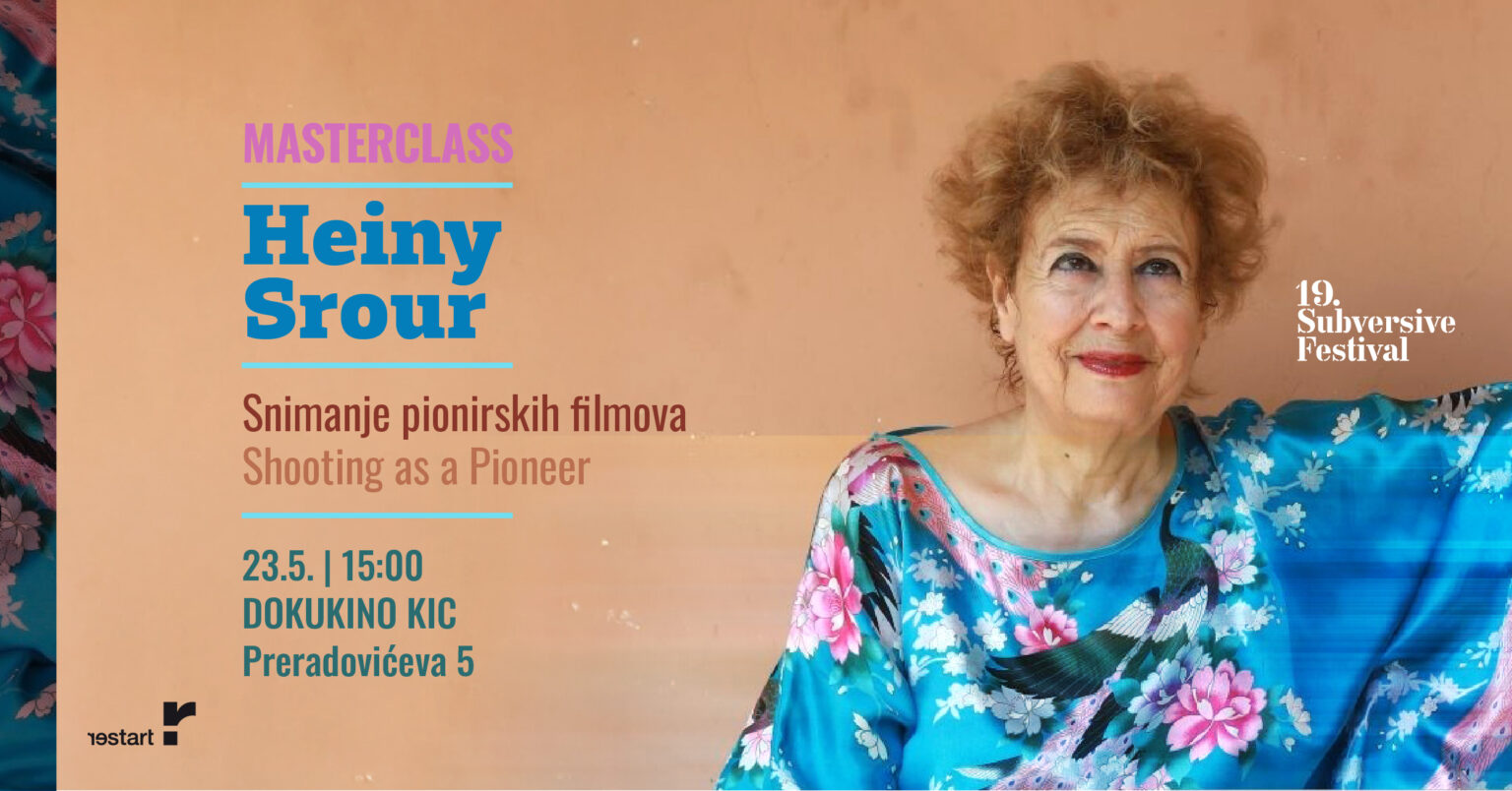
On Saturday, 23rd May at 3 p.m., as part of the 19th edition of Subversive Film Festival, the renowned Lebanese filmmaker Heiny Srour will give a masterclass titled Shooting as a Pioneer, where she will navigate us through her mosaic oeuvre, comprising rarely seen and oftentimes banned films weaving together anticolonial struggle with a feminist perspective and revolutionary political imagination.
Heiny Srour has always been a pioneer, a revolutionary, in a substantial as well as a formal sense, going off the beaten tracks. In her masterclass, she will take up the following questions: Why was she the first, in the whole of Arab cinema, to make films in Dhofar, as well as Vietnam? What pushed her to innovate in different aspects of her filmmaking? Why has she always taken the side of the oppressed and why does radical socialism work only by means of horizontal solidarity? How did her unconscious and the collective unconscious of Middle Eastern women come together during the filming in extreme situations?
Heiny Srour is a filmmaker known for her political and feminist films, which she made in near-impossible conditions, in the midst of wars in the colonized parts of the Middle East, from Palestine and Lebanon to Oman. She arrives to Zagreb at the invitation of the Subversive Festival, to receive the Wild Dreamer Prize for Lifetime Achievement. A retrospective program, to be shown at Kino Kinoteka and Dokukino KIC, includes her films The Hour of Liberation Has Arrived, Leila and the Wolves, The Singing Sheikh and Rising Above: Women of Vietnam.
The Hour of Liberation Has Arrived (1974) is the first documentary to be made about one of the most radical conflicts in the Arab world, but also about daring feminism as embodied by The People’s Front for the Liberation of the Occupied Arabian Gulf in the ex-Liberated Zone of Dhofar, Oman. In order to make this film, Srour and her crew travelled 500 miles across the war-torn country under bombardment. It is also the first film by an Arab female filmmaker to be screened at Cannes Film Festival. It dismisses the bourgeois notion of ‘objectivity’, taking a stance with no ambiguity, making no effort to conceal any contradictions and difficulties of the struggle, all the while eschewing pointless triumphalism. The montage as a whole was conceived to bring forth an analysis of an armed resistance by the people.
Leila and the Wolves (1984), inspired by the Arabian Nights tradition of storytelling, embarks on an archaeological excavation of the collective memory of Arab women, drawing inspiration from it to construct a distinct female and feminist counter-consciousness. In this hybrid masterpiece, Leila the protagonist rejects a colonial and masculine version of history, travelling through time and space, through the span of eighty years of Middle Eastern history, with the aim of revealing the hidden role of women and the real face of patriarchy. The film fuses fictional narrative, archival images with elements of myth and folklore.